
Wedge Rolling
Theory
Transverse Wedge Rolling is a metal forming process in which a round billet is inserted between appropriately shaped rolls or flat plates that deform the workpiece as it rotates. These tools incorporate a wedge-shaped profile, from which the process takes its name.
There are several versions of the Transverse Wedge Rolling process, depending on the type of tooling and motion involved.
- If rolls are used, they rotate in the same direction and drive the workpiece. In this case, either two or three rolls can be used.
- If flat tools are used, they move in opposite directions while rotating the workpiece between them.
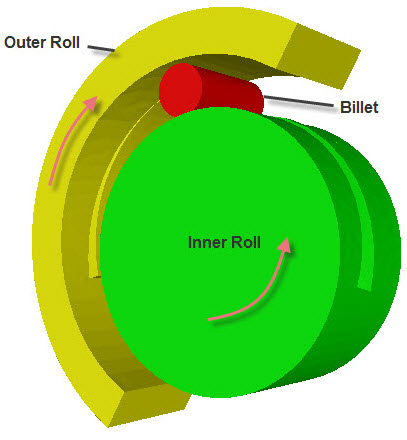
- A planetary system with a single large work roll and a fixed work segment is also possible. In addition, concave tooling segments can be used.
In the planetary rolling configuration, a large rotating roll works together with fixed or concave tooling segments to progressively deform the billet as it rotates. This setup allows continuous deformation and improved material flow.
In the three-roll Transverse Wedge Rolling system, three rolls surround the billet and rotate simultaneously. The wedge-shaped profiles on the rolls deform the billet uniformly as it rotates, producing the desired shape.
.jpg)